Burleith's Living History
/BACK TO THE FUTURE WITH BETH, IOANA, AND MAUREEN
By Forrest Bachner
Beth McKinney is a dental hygienist and pastor of the Palisades Community Church who lives on T Street. Maureen Long, also of T Street, retired a year ago as an intensive care nurse at the Washington Hospital Center. Ioana Razi, MD, is a pediatrician in private practice living on R Street. But in the early 1950s and 60s these women were three little girls growing up in our “Village in the City.”
How they got here
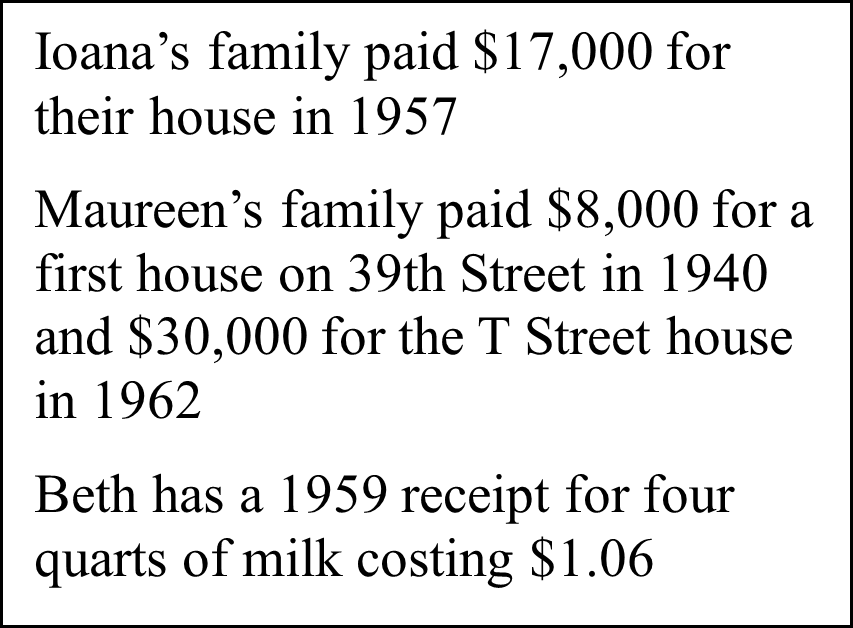
Beth’s mother moved to Washington to be a secretary at the Pentagon during the war. Her father, after serving in the war, went to college at Ben Franklin University (now a part of George Washington University) on the GI bill and became an accountant for the IRS.
Ioana’s parents came as immigrants from Romania via Paris and New York. (For their story see: http://www.burleith.org/whatsup/2022/2/28/focus-on-eggie-razi) Her father came to Washington to work for Voice of America. A Romanian friend recommended Burleith owing to the good schools and a close-to-work location. Ioana was the third of four children.
Maureen’s parents were also immigrants, arriving from Ireland. Her mother, speaking only Gaelic, arrived from Galway with a note pinned to her sweater asking for someone to send her to a relative in Pittsburgh. Later, searching for work, she ended up in Washington, where she met Maureen’s father, originally from Kerry, at the Irish Club of America. They chose Burleith because the houses were a reasonable price and a desirable distance (read not close) to an uncle also residing in the city. The family first lived on 39th, later moving to a bigger house on T to accommodate seven children.
Burleith then
All three women remember Burleith as a solidly middle-class community in those post-war years with lots of government workers. Both Ioana and Maureen shared a room with a sibling or siblings. Beth was an only child. None of the three saw their houses as small. Few mothers in the neighborhood worked, and most children went to the local public schools: Fillmore for elementary, then Gordon Junior High, (now Hardy), and Western High School (now Duke Ellington).
Ioana and Beth attended Fillmore School but in different years. Ioana remembers a Mrs. Fanari, who, in a blue skirt and white shirt uniform served as the 35th Street crossing guard who knew every child, their parents, and where each family lived. Ioana also mentioned that children attending Fillmore could go home for lunch. Maureen attended Holy Trinity from first grade through high school. She was careful to note that she was never a VISI, short for Visitation-girl. (There must be a story there.)
According to all three women, life as a Burleith child was glorious. Simple but glorious. A time of coming home from school and going right back out to join gangs of kids skating or biking in the alleys, roaming the woods, and revolving in out of neighbors’ houses as easily as their own and coming home only at dinner time. Or in the case of Maureen’s family, when her mother would stand on the front stairs and ring a bell. There was also Montrose Park with tennis and croquet, long, lazy days at the Volta Park playground and pool, as well as day camp in the Glover Park woods. Safety was never a concern for anyone.
Neighbors played a huge role in this glorious childhood for Ioana, Maureen, and Beth. “Everyone was so friendly.” “Everyone knew everybody.” For Beth, the elderly next-door neighbors were her grandparents; Ioana remembers that she and her siblings were literally in four of her neighbors’ houses every day; and Maureen mentioned that when she came of age, a long-time 39th Street neighbor taught her how to make her first gin and tonic.
Beth recalls grownup neighbors parenting children as if they were all their own. For good and bad. She remembers adult neighbors handing you a dollar to get milk for them at the corner market. One neighbor, Colonel Curtis, asked Beth’s father to bring her, and her little hand, to remove a stuck item from his garbage disposal. And he did. Neighborhood kids delivered newspapers and then went house to house to collect their fee. A T Street resident made candy apples for every child in Burleith at Halloween.
Wider Washington
In addition to the pleasures of Burleith, the women all commented on the extraordinary benefits of living in Washington as a child, benefits like watching the concerts set on a barge in the Potomac from the back steps of the Lincoln Memorial, viewing the Mona Lisa in 1963 at the National Gallery, attending the White House Easter egg roll and the lighting of the White House Christmas trees. AND:
-Maureen’s family sitting in the pew in front of John F. Kennedy and his family at Holy Trinity.
-Ioana walking with her father to hear John Kennedy give a campaign speech from the steps of his N Street house.
-Maureen performing as part of an Irish dance group at Lyndon Johnson’s inauguration.
-Ioana seeing Neva Wicker (wife of New York Times journalist, Tom Wicker,) dressed for JFK’s inauguration ball.
-Maureen and her sister babysitting for CBS broadcaster Dan Rather’s children on R Street.
-Beth winning a city-wide coloring contest held by the MPD’s Officer Friendly Program and receiving two Gold Tickets for the President’s Box at a Washington Senators game along with a baseball autographed by the team.
Looming over this glorious childhood, though, were civil rights struggles and cold war fears. Segregation was a tragic fact of life in Washington in the fifties and early sixties. Ioana, whose family left the neighborhood for a diplomatic tour in Africa when she was in the fifth grade (1963), recalls having met only four Black people before leaving. Beth remembers her second-grade year (1968), with Black students bused in from Anacostia to attend Fillmore but her mother refused to allow her to invite a Black classmate to a birthday party. Beth can also see herself as a little girl trooping to the bomb shelter at Fillmore in the years following the Cuban Missile Crisis, and Maureen remembers the haze of smoke from the 1968 riots.
Burleith now
All three women left Burleith at one time or another—for education, jobs, a parent’s work, the usual reasons. But then they all came back. Beth and Maureen to care for aging mothers and Ioana to live near her parents and move “home.”
All three enjoy Burleith and are very happy to live here. They spoke of the closeness to woods and trails, Georgetown, the river, walkability, and public transportation access to everything! Some of the newer renovations, however, are seen as problems with a loss green space and when light and air are blocked to neighbors’ yards. The stores and restaurants now lining Wisconsin, where once only the Safeway and Dart Drug stood, are much appreciated.
All three, however, commented on a sense of loss of community.
The reason for the loss? To a great extent, times have simply changed. Most women work. Fillmore School closed. Children attend a variety of public, charter, and private schools. They certainly don’t deliver newspapers anymore and only rarely hire out to do chores for neighbors. We also seem to be more scheduled. Plus, we have air conditioning! And mosquitoes! Where, once adults sat on stoops and porches chatting with one another while children played outside, we retreat to the cool, bug-free indoors. Where once neighbors caught up over lawn mowers and spades, these days most people hire services. Where once the BCA met monthly, we now have an annual meeting and a listserv. And on and on.
But something else seems to be at work, too, something harder to understand. All three women said as children they knew everyone on their blocks. Now they know fewer. I wonder, if we all did a count, how many neighbors we could say we know just on the block where we live.
We are so lucky to live in Burleith with our many wonderful traditions: the picnic, the Gløgg party, decorating contests, Santa, the Bell, our BCA, and the Burleith Special Interest Groups. But maybe it’s time to go back to the future with Beth, Maureen, and Ioana and greet our neighbors…right next door.
Postscript: While the January snowstorm created all sorts of problems it did bring neighbors outside as a group to sled, spread ice melt, shovel sidewalks, and dig out cars. AND to chat, complain, and commiserate with one another. A back to the future moment for sure.
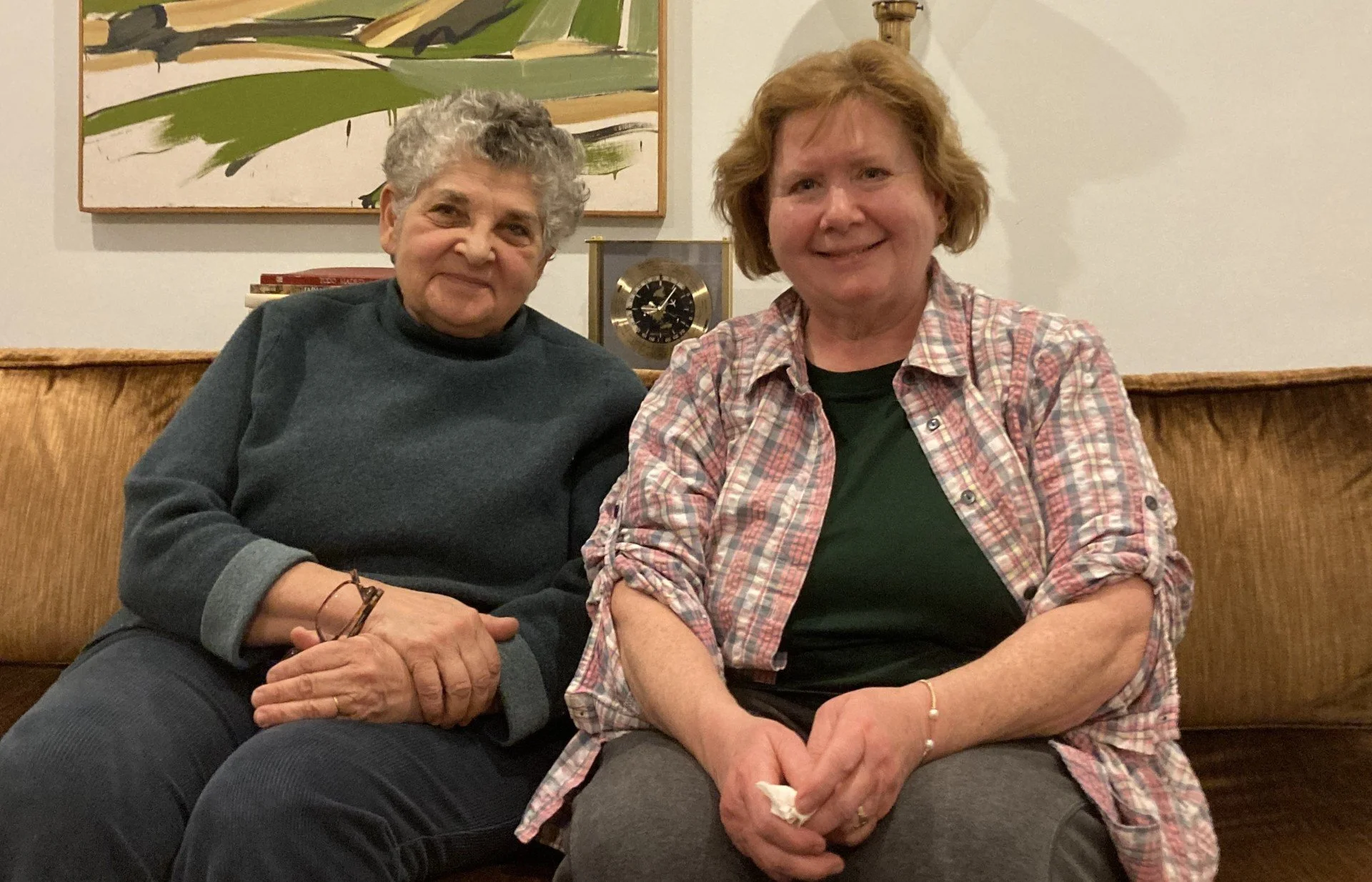
Ioana and Maureen